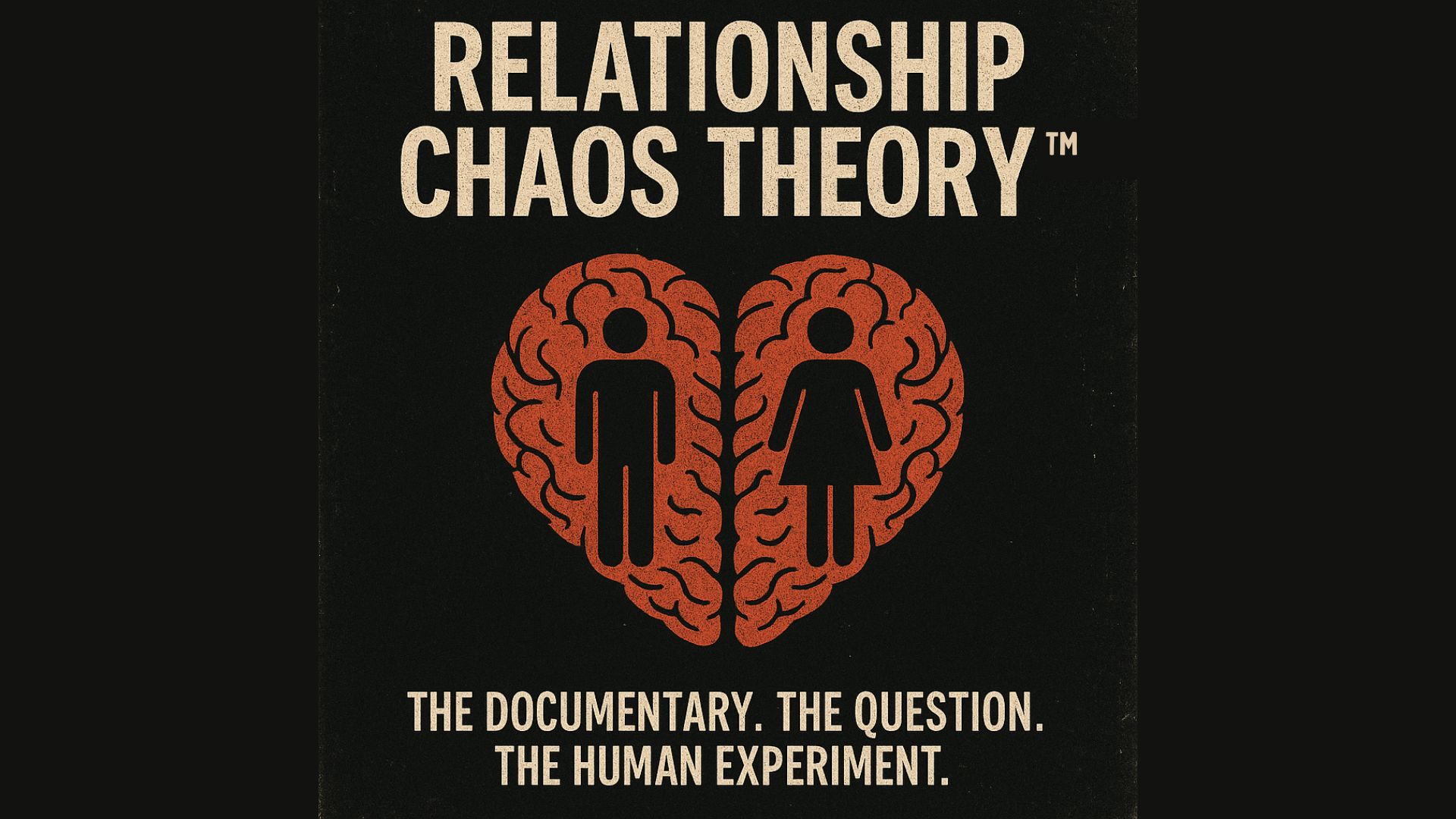
relationship chaos theory™

Love isn’t the problem.
People didn’t suddenly forget how to connect.
Men and women aren’t failing at relationships.
The system failed.
Modern relationship pain isn’t a personal dysfunction.
It’s predictable behavior playing out inside badly designed social systems.
And most people aren’t failing loudly —
they’re failing quietly through confusion, overthinking, hesitation, and walking away from things that could’ve worked.
The Love & Logic Experiment™ exists to test that idea in real life.
The System That Taught You How To Love... Also
Watch Why This Experiment Exists
This is the system you were taught to love inside.
Not through conspiracy.
Through incentives.
This short teaser outlines the core hypothesis behind The Love & Logic Experiment™ —
why modern relationships feel harder than they should,
and why so many well-intentioned people keep getting the same frustrating outcomes.
Watch this if you’ve ever thought:
“I’m self-aware… so why does this still feel broken?”
Once you see the system, it’s hard to unsee how much of your behavior makes perfect sense.
This isn’t a pitch.
It’s the question everything else on this page is built around.
If this resonates, the entry points below show you how to engage — at whatever depth makes sense for you.
THE LIVE EXPERIMENT
For the last century, the way we connect has been engineered.
Biology turned into ideology.
Emotions turned into content.
Confusion turned into profit.
And when it stopped working, we were told to "fix" ourselves.
What if the problem wasn’t you —
but the incentives you were taught to relate inside?
The Love & Logic Experiment™ is an ongoing social experiment testing what actually works when people stop reacting inside the chaos and start relating with clarity, agency, and emotional logic.
At any given time, the experiment is running:
conversations, surveys, media breakdowns, live tests, and real-world labs — all feeding back into what we keep, what we discard, and what we refine.
You don’t have to join a program.
You choose how you engage.
You don’t need permission to be here.
You’re already inside the system shaping modern relationships —
this just gives you a way to engage with it consciously instead of reactively.
CHOOSE YOUR ENTRY POINT
Observe & Decode The Chaos
Cultural breakdowns of dating debates, therapy trends, and gender wars — without picking sides.
Best if you want clarity without being talked down to.
Add Your Opinions & Data
Anonymous surveys, games, and real scenarios that capture what people are actually experiencing.
Best if you’re tired of hot takes and want someone to actually listen.
Test This In Your Own Life
Practical tools for reading behavior, regulating reactions, and stopping the same patterns from repeating.
Best if you’ve “done the work” but want better results.
See What Happens in Real Rooms
Live labs for singles and couples where attraction, safety, and connection are tested with real humans.
Best if you’re done intellectualizing and want proof.
Help Prove (or Disprove) the Theory
Be part of the long-form documentation shaping where this goes next.
Best if you care more about truth than guarantees.
Read the Field Guide
The Love & Logic book is the operating manual behind the experiment.
Best if you want a low-barrier, self-paced way to understand the logic before stepping deeper into the experiment.
THE PROVING GROUNDS
(Why this even matters)
Modern relationship advice isn’t just confusing.
It’s conditioning people into patterns that quietly backfire —
even when they’re trying to do everything “right.”.
People are being taught to:
... Lead with intensity instead of safety
... Confuse emotional exposure with intimacy
... Use boundaries as leverage instead of clarity
... Turn self-awareness into self-surveillance
And then they’re shocked when:
... Attraction fades
... Communication gets tense
... Situationships drag on
... Commitment feels harder, not easier
The result isn’t empowerment.
It’s hyper-vigilance.
Everyone’s “doing the work.”
Everyone’s analyzing everything.
And somehow, relationships feel colder, riskier, and more exhausting than ever.
That's not a coincidence.
The Love & Logic Experiment™ exists to test a different premise:
When people understand behavior, incentives, and emotional safety —
not just feelings and language —
relationships get simpler, not harder.
You don’t need more insight.
You need better mechanics.
That’s what we’re testing here — in public, in private, and in real life.
What This Isn't
This Isn't:
Therapy
Gender warfare
Spiritual cosplay
A personality transplant
What This Is
This Is:
Behavior over branding
Incentives over intentions
Emotional agency without blame — and without self-erasure
No one here owes anyone anything.
That’s not harsh. That’s freedom.
WHO THIS WORKS FOR
This will likely resonate if:
... You’re pattern-aware but still getting stuck
... You want clarity more than validation
... You’re done with performative emotional intelligence
This will probably annoy you if:
... You want someone to blame
... You need certainty before participation
... Identity matters more to you than choice
The Experiment™ Ecosystem
The Experiment shows up in different forms depending on how people learn best:
Media & commentary for awareness
Games & surveys for pattern recognition
Tools & practice labs for real-life application
Live environments for embodied proof
Long-form documentation for cultural impact
Different doors.
Same question.
We’re not trying to be right.
We’re here to see what actually works.
If modern relationships feel harder than they should,
you’ve already been living inside the experiment.
The only question is whether you keep guessing
or start seeing what’s actually happening.
Follow the Experiment


